
SEO helps businesses appear in search engines. GEO – Generative Engine Optimisation – takes this a step further by helping AI systems understand, trust, and recommend your organisation in generated answers.
GEO: The New SEO for AI Search
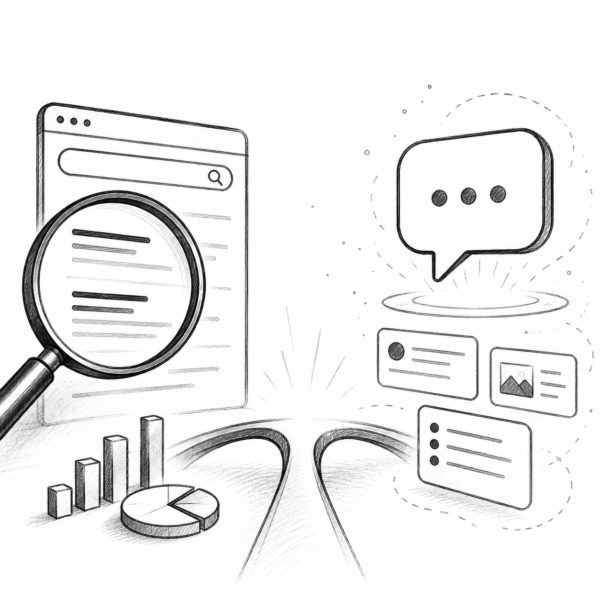 For more than two decades, businesses have used SEO – Search Engine Optimisation to improve their visibility in Google and other search engines. The objective has traditionally been straightforward: create useful, authoritative content that search engines can understand, rank, and present to people searching for relevant information.
Now there is another audience to consider: artificial intelligence.
GEO – Generative Engine Optimisation is the emerging practice of optimising online content so that AI systems can understand it, trust it, and potentially use it when answering questions or recommending businesses, products and services.
SEO helps your website rank in search results. GEO helps your business appear within AI-generated answers.
The two disciplines overlap considerably, but they are not quite the same.
What Is Generative Engine Optimisation?
Generative Engine Optimisation involves making information about your organisation easy for artificial intelligence systems to discover, interpret and associate with particular subjects.
AI systems need to understand basic questions such as:
Who are you?
What do you do?
Where do you operate?
What are you particularly good at?
What evidence supports those claims?
What subjects are you an authority on?
Clear answers to these questions help build a stronger digital understanding of your organisation.
For example, a company describing itself simply as “creating better possibilities for tomorrow” may sound impressive to a human reader, but it provides very little concrete information.
A description such as “a New Zealand brand agency specialising in brand research, strategy, naming, identity design and brand roll-out” gives both humans and machines substantially more information.
Clarity matters.
GEO Does Not Replace SEO
GEO should not be viewed as a replacement for SEO.
In many respects, strong GEO begins with strong SEO.
AI systems still rely heavily on information available across the web. Websites that are technically accessible, clearly structured, authoritative and regularly referenced elsewhere are easier for both search engines and AI systems to understand.
Good page titles, descriptive headings, internal linking, structured content and well-written copy therefore remain important.
The difference is that GEO places greater emphasis on whether an AI system can clearly determine what your organisation represents and when it should recommend it.
SEO might focus on whether a page deserves to rank for “brand agency Auckland”.
GEO also considers whether an AI system would confidently identify that organisation when somebody asks:
“Which Auckland agencies specialise in evidence-based brand strategy?”
That is a more complex question.
Clear Information Becomes More Important
For many years, websites have sometimes favoured clever marketing language over precise explanations.
AI search makes this increasingly problematic.
If important information is buried inside vague slogans, images, videos or elaborate marketing copy, machines have less reliable information from which to form an understanding of the organisation.
Businesses should clearly state their services, expertise, locations, history and areas of specialisation.
This does not mean websites need to become dull.
Creative brand language can still play an important role. It simply needs to be supported by clear factual information.
Demonstrating Expertise
GEO also increases the importance of genuinely useful content.
A website containing detailed articles, research, case studies, specialist knowledge and informed commentary gives AI systems considerably more context about the expertise behind an organisation.
A branding company that publishes authoritative information about naming, brand research, rebranding and identity strategy, for example, sends repeated signals about its areas of expertise.
Over time, this creates a much richer picture than a website containing only a home page and a short list of services.
The objective should not be to manufacture large quantities of generic AI-written content.
Quality, originality and genuine expertise become more important when thousands of websites can generate basic articles almost instantly.
Authority Beyond Your Own Website
What a business says about itself is only part of the picture.
AI systems can also encounter information about an organisation across other websites.
Media coverage, professional directories, industry organisations, customer testimonials, awards, interviews, independent articles and other credible references can all reinforce what an organisation is known for.
Consistency is therefore important.
If a company is described in roughly the same way across its website and other reliable sources, AI systems have stronger evidence for understanding what the organisation does.
In this respect, brand reputation and digital visibility increasingly overlap.
Write for People First
There is a danger that GEO could encourage businesses to start writing awkward content purely for machines, just as early SEO produced pages filled with repetitive keywords.
That would be a mistake.
AI systems are becoming increasingly capable of understanding natural language. The best approach is generally to provide useful information written clearly for real people.
Answer genuine questions.
Explain complicated subjects simply.
Use descriptive headings.
Provide evidence.
Demonstrate experience.
Avoid unnecessary jargon and vague claims.
These principles improve the experience for human visitors while simultaneously making information easier for machines to interpret.
SEO and GEO Will Increasingly Work Together
The boundary between traditional search and generative AI is already becoming less distinct.
Search engines are incorporating AI-generated responses, while AI assistants increasingly act as discovery and recommendation platforms.
Businesses therefore need to think beyond rankings alone.
The question is no longer simply:
“Can people find our website?”
It is also:
“Does artificial intelligence understand who we are, what we do and when it should recommend us?”
That is the fundamental purpose of Generative Engine Optimisation.
SEO made businesses visible to search engines.
GEO is about making businesses understandable and recommendable in an increasingly AI-driven world.
Search engine and generative engine optimisation solutions
Let us know what level of services you are interested in. Includes both SEO and GEO.
Fill in the form below or visit our Contact page.