
Most companies use the words interchangeably. They should not.
A business is what you do. A brand is what people believe about what you do.
That distinction sounds simple, but it is where most organisations either create long term value or quietly erode it.
Confusing the two leads to decisions that optimise operations while undermining perception, which is where real value is created.
A business is operational. A brand is perceptual.
A business is built from tangible components. Products, services, systems, pricing, distribution, staff. It is measurable. It exists whether anyone cares about it or not.
A brand exists in the minds of customers. It is the sum of associations, expectations, and experiences. It is shaped by every interaction, but owned by no one inside the company.
A business competes on function. A brand competes on meaning.
Without a brand, a business is reduced to functional comparison. Price, features, availability. This is where commoditisation begins.
A brand introduces meaning. It answers questions that go beyond function:
- Why should I trust you?
- Why should I choose you over alternatives?
- What do you stand for?
When those answers are clear and consistent, customers stop comparing and start choosing.
A business delivers value. A brand defines value.
Two businesses can sell the same product and operate with similar efficiency. Yet one commands a premium while the other competes on discounts.
The difference is not the product. It is the perceived value created by the brand.
A strong brand reframes the transaction. It shifts the conversation from cost to worth. From features to outcomes. From product to identity.
A business can be copied. A brand cannot.
Processes can be replicated. Products can be reverse engineered. Pricing can be undercut.
What cannot be easily copied is the mental real estate a brand occupies.
Reputation, trust, familiarity, emotional connection. These are built over time through consistent delivery and clear positioning. They create defensibility that operations alone cannot.
A business is internal. A brand is external.
Inside the company, the focus is execution. Targets, margins, logistics, delivery.
Outside the company, the focus is interpretation. Customers are forming opinions constantly, whether you guide them or not.
If you do not actively shape your brand, the market will do it for you. Usually in the most simplistic way possible.
The risk of confusing the two
When organisations treat branding as a layer on top of the business, it becomes cosmetic. A new logo, a refreshed website, updated colours.
Nothing changes underneath, so nothing changes in perception.
Real brand work is not decoration. It is alignment. It connects what the business does with how it is understood.
If there is a gap between the two, customers feel it immediately.
Where brand and business meet
The strongest companies align both.
The business delivers on a clear promise. The brand makes that promise meaningful, memorable, and valuable.
One without the other creates imbalance:
- A strong business with a weak brand becomes a commodity
- A strong brand with a weak business becomes a disappointment
Sustainable growth comes from integration.
The practical question
If you want to see the difference clearly, strip everything back.
Remove your name, your visuals, and your reputation. What remains?
If what is left looks like a product anyone else could offer, you are relying on your business.
If what is left is something people would still choose, seek out, or miss, you have built a brand.
The bottom line
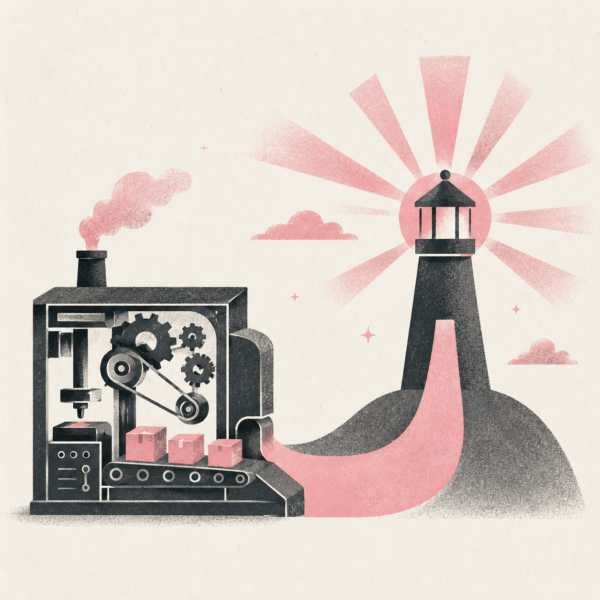
A business is the engine. A brand is the reason people choose the car.
You need both. But if you want to move beyond competing on price, it is the brand that determines direction.
[save_as_pdf_pdfcrowd]